Overview
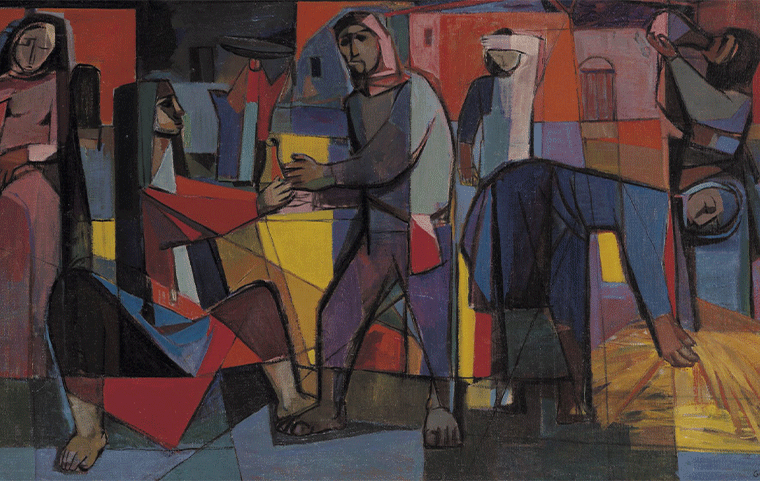
As defined by their name, Jamaat Baghdad Lil Fan al-Hadith, the Baghdad Modern Art Group was established to negotiate modern art between Baghdad as a centre of production and the rest of the world. It thus drew from both the history of its location in Baghdad, an Abbasid city that traces its lineage to the ancient civilisations of the Fertile Crescent, and its own age as manifested in modernism. Initiated in 1951 by two of Iraq’s most influential artists, Jewad Selim (1919–61) and Shakir Hassan Al Said (1925–2004), the group grew to engage many of Iraq’s leading visual artists and architects. Its legacy, however, reached beyond its active years and geographical borders, and its teachings continue to impact the Iraqi art scene today. Nevertheless, while the group is known by name, and its manifesto has been translated and published several times in the last decade, to date, no exhibitions or publications have delved deeper into its history.
The exhibition aims to historicise the group, its aesthetics and its legacy through providing visual and textual contexts. It examines the group’s development through the work’s evolution of its two leaders and the contributions of its original members, as well as tracks the changing membership over the collective’s first decade and the attempts at continuity after Selim’s untimely death. It does so through mapping the group’s exhibition history. The exhibition considers the group’s impact on following generations through education and presence in the work of succeeding groups who challenged its philosophies and objectives, such as the New Vision Group and lesser studied ones like al-Mujaddidin (1965). It further investigates relationships between the artists, as colleagues and teachers, which led to the dissemination of their ideas today via the ‘Eighties Generation’ of Iraqi artists, who currently live mostly in diaspora, a further loss to Iraq’s cultural and artistic development.